Copper gutters: when they make sense
Copper is a niche product, and it is best to say so right away: on the vast majority of homes, it does not drain water any better than aluminum. It costs more and comes with metal-compatibility requirements that few homeowners know about before signing. There are, however, buildings for which it is the logical choice.
Three situations where copper truly belongs
The reasoning is architectural, not functional: copper is justified when the building calls for it, not when the goal is to improve drainage.
Heritage building
On an older home, church, or designated heritage building, copper is part of the original architectural vocabulary: copper flashing, copings, and downspouts were standard practice before aluminum. A painted gutter disrupts the building’s appearance.
Architect-designed home
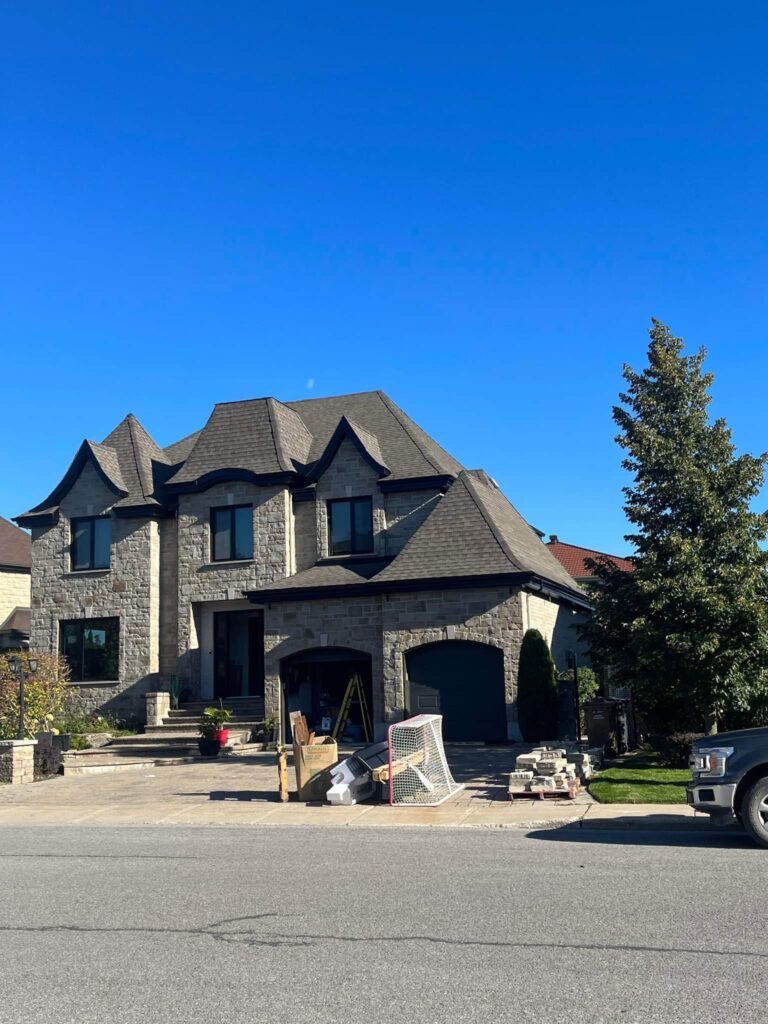
When the exterior combines premium materials—stone, solid wood, zinc, glass—and the rooflines are visible from every angle, copper is part of the design. The gutter is not a hidden accessory: it is a visible element.
Existing copper roof
This is the clearest case. If the roof is already copper, the gutter must be copper as well, and not only for appearance: water running off a copper roof attacks an aluminum gutter.
Patina: a change you need to accept in advance
New copper is shiny, almost pinkish. It does not stay that way. Exposed to air and rain, it first dulls, takes on brown shades, then chocolate tones, and eventually develops the verdigris everyone associates with old church steeples. This is the metal’s normal behaviour, not a manufacturing defect or an installation problem.
Two things need to be stated plainly. First, the change is effectively irreversible: copper does not return to its new appearance. Lacquered and pre-patinated copper are available, but lacquer deteriorates unevenly and the patina then reappears in patches. Second, it does not progress uniformly: surfaces exposed to rain change faster than those protected by an overhang, soffit, or wall, and not all elevations age at the same rate. On the same building, there will be different tones throughout the transition.
Water leaving a copper surface also carries metal compounds and can stain whatever it touches below: brick, stone, concrete, wood, exterior cladding. This must be considered when deciding where water will fall and where downspouts will discharge. It is a decision to make before installation, not a correction to make afterward.
Our position is simple: if the idea of the metal turning brown and then green bothers you, copper is not the material to choose. No one should buy it expecting it to remain shiny.
Galvanic corrosion: the technical point not to overlook
This is where copper projects most often go wrong. When two different metals are in contact in a wet environment, they form a galvanic cell: one corrodes while the other remains intact. Copper is the more noble metal in the pair; aluminum and galvanized steel are the metals that deteriorate.
In practical terms, everything that touches copper must be compatible: hangers and brackets, rivets, screws, downspout straps, elbows, flashing, and connections. Copper, brass, or stainless steel must be used. A single forgotten galvanized screw in a copper gutter becomes a point of corrosion.
The lesser-known trap is runoff. The two metals do not need to touch: water flowing from a copper roof, flashing, or coping picks up compounds along the way and then attacks the aluminum it encounters lower down. This is why an aluminum gutter installed below a copper roof is a mistake, even if the rest of the installation is flawless.
Connections to existing components require the same attention. An aluminum-clad fascia, existing aluminum capping, or an aluminum leaf guard creates a pairing with copper. Depending on the situation, the metals must be separated, compatible components selected, or the accessory omitted.
What installation changes in practical terms
An aluminum gutter is formed continuously on site from a coil. Copper comes in custom-shaped lengths and is joined with soldered seams, with expansion joints wherever the metal needs room to move: this is sheet-metal work, not machine roll-forming. Copper is also heavier than aluminum, so the fascia must be sound and more supports are required. Any future repair will require a soldering specialist and matching components.
Copper or aluminum: what actually changes
| Aspect |
Copper |
Aluminum |
| Appearance over time |
Changes continuously, from shiny to brown and then green |
Stable painted finish, with the colour selected from the outset |
| Assembly |
Custom-shaped lengths, soldered seams |
Continuous gutter formed on site |
| Components in contact |
Copper, brass, or stainless steel required |
Common compatible accessories |
| Contact with other metals |
Attacks aluminum and galvanized steel |
Deteriorates when in contact with copper |
| Finish |
No paint to maintain |
Factory finish, with touch-ups depending on condition |
| Repair |
Requires a soldering specialist and matching components |
Widely available parts and accessories |
| Drainage capacity |
Depends on gutter size and downspouts, never on the metal |
On an ordinary home, copper costs more for no benefit
Let us be direct: on a bungalow, cottage, or standard suburban home, copper provides no functional advantage over aluminum. Water does not flow better through a copper gutter. The slope, gutter size, and number and placement of downspouts do all the work. Paying for copper on these homes means buying an appearance that the building’s style does not call for.
The money is better spent elsewhere: a 6-inch gutter where the roof concentrates water, properly placed downspouts, fascia repairs before installation, a targeted repair instead of full replacement, and regular cleaning based on the trees around the home.
How we approach a copper project
We start on site: with the building, its style, the existing roof, and above all an inventory of the metals already present—flashing, capping, brackets, and anchors. We then determine what must be replaced to remain compatible, and put it in the quote rather than discovering it during the project. If copper is not justified, we say so and recommend the aluminum gutter installation that suits the building.
Our Service Area
Gouttières et Revêtements Synergy is based at 580 Chem. de Lavaltrie, local 103, Lavaltrie QC J5T 0H1. We hold RBQ licence 5723-4940-01, are Alu-Rex ÉLITE Installer, CAA-Québec Recommended and APCHQ Certified. We serve Lanaudière, the Laurentides, the North Shore, Laval and Montreal.
Get My Free Quote Call 450-559-5648