
Downspouts | Sizing, Placement & Repair
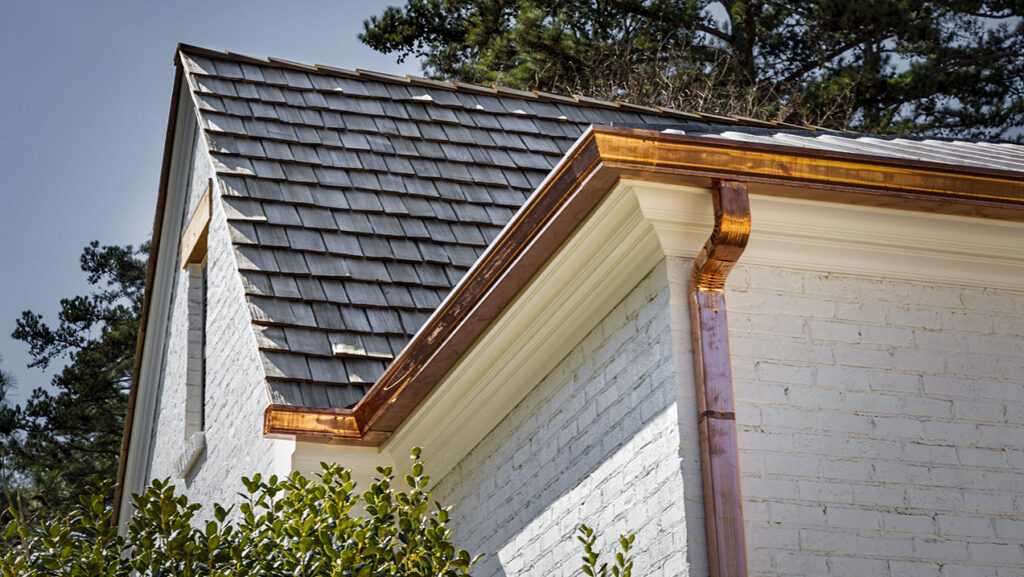
A gutter only carries water. The downspout is what drains it away. Everything the roof sends into the trough has to pass through an opening much smaller than the trough itself before reaching the ground. That is where the system backs up first, not elsewhere. Even a new, properly sloped gutter will overflow if there are too few downspouts or if they are poorly positioned. Gouttières et Revêtements Synergy holds RBQ licence 5723-4940-01 and serves Lanaudière, the Laurentides, the North Shore, Laval and Montreal.
The real bottleneck
Water enters the gutter along the entire length of the roof. It leaves through only a few points. When rainfall intensifies, the trough fills until incoming flow exceeds what the outlets can handle, and the excess spills over the front edge. The slope or fasteners are then blamed. Often, the system simply needs another outlet.
A blockage follows the same logic. A gutter full of leaves is visible from below and can be cleaned. A clogged outlet is not: the gutter holds water constantly, overflow returns to the same spot, and standing water puts stress on the hangers.
How many downspouts, and where to place them
The number should be determined by concentration points, not by the symmetry of the façade. A valley directs the runoff from two roof slopes onto a short section of gutter. An L-shaped roof brings everything into the inside corner. A long façade served by a single outlet at one end forces all the water to travel the full length of the gutter before draining: the gutter must remain full to feed that single outlet, leaving no margin when rainfall becomes heavy.
The location at ground level matters just as much as the location at the top. A downspout should not discharge above an entrance, sidewalk or stairway: what melts during the day freezes at night, exactly where people walk. Nor should it be tucked away in an inconspicuous corner if water is concentrating elsewhere.
What happens when a downspout discharges against the foundation
The backfill around a foundation is disturbed soil, looser than the original ground. Water discharged there at a single point does not spread out: it runs down along the wall to the footing and drain. The backfill erodes and settles, and the ground eventually slopes toward the house. The problem worsens on its own: the depression that forms directs even more water back to the same spot.
Then come freeze-thaw cycles. Saturated soil expands when it freezes: it pushes against the foundation wall and lifts slabs, patios and steps resting against it. Dry soil does not do that. The remaining water follows the weakest path, either the joint between the slab and the wall or an existing crack—this is the classic route for water infiltration into a basement. Higher up, repeated splashing wets and stains the lower portion of the exterior cladding.
Keeping water away from the base of the wall
The outlet elbow and extension are used to move water out of the backfill area and discharge it onto ground that slopes away from the building. Put plainly: an extension that ends on level ground, or slopes toward the house, only moves the puddle. When the grading is wrong, no extension length will correct the problem. That is landscaping work, not gutter work, and we will say so rather than sell an unnecessary part.
Connecting to a drain
Burying the discharge provides a clean finish and clears the area around the house. There are two cautions, however. First, many municipalities prohibit connecting a gutter downspout to the sewer; the rule must be confirmed with your municipality before digging. Second, a buried pipe can become clogged without being visible: sand, shingle granules, roots. When it blocks, water backs up into the downspout and comes out exactly where it was not meant to go—against the foundation. A buried connection therefore requires an access point for cleaning and an outlet with proper slope. Without both conditions, a surface extension is less elegant, but it can be checked at a glance.
Add an outlet
The number and routing of downspouts can be revised without replacing the entire system when the gutters are still in good condition. See gutter installation.
Detached or loose downspout
The joint between the gutter and elbow is stressed with every rainfall and every freeze. When it comes apart, it discharges water directly at the base of the wall.
Clogged outlet
A leaf guard limits what enters the gutter, but granules and sand can still reach the lower elbow. See gutter guard installation.
Assess before deciding
The number and placement of downspouts are determined on site: the roof areas draining into each section, valleys, corners, ground slope and the location of entrances. We show where water is concentrating and what falls within the scope of gutter work—and what does not.
Our Service Area
Gouttières et Revêtements Synergy is based at 580 Chem. de Lavaltrie, local 103, Lavaltrie QC J5T 0H1. We hold RBQ licence 5723-4940-01, are Alu-Rex ÉLITE Installer, CAA-Québec Recommended and APCHQ Certified. We serve Lanaudière, the Laurentides, the North Shore, Laval and Montreal.