
Exterior Insulation | Added During Siding Replacement
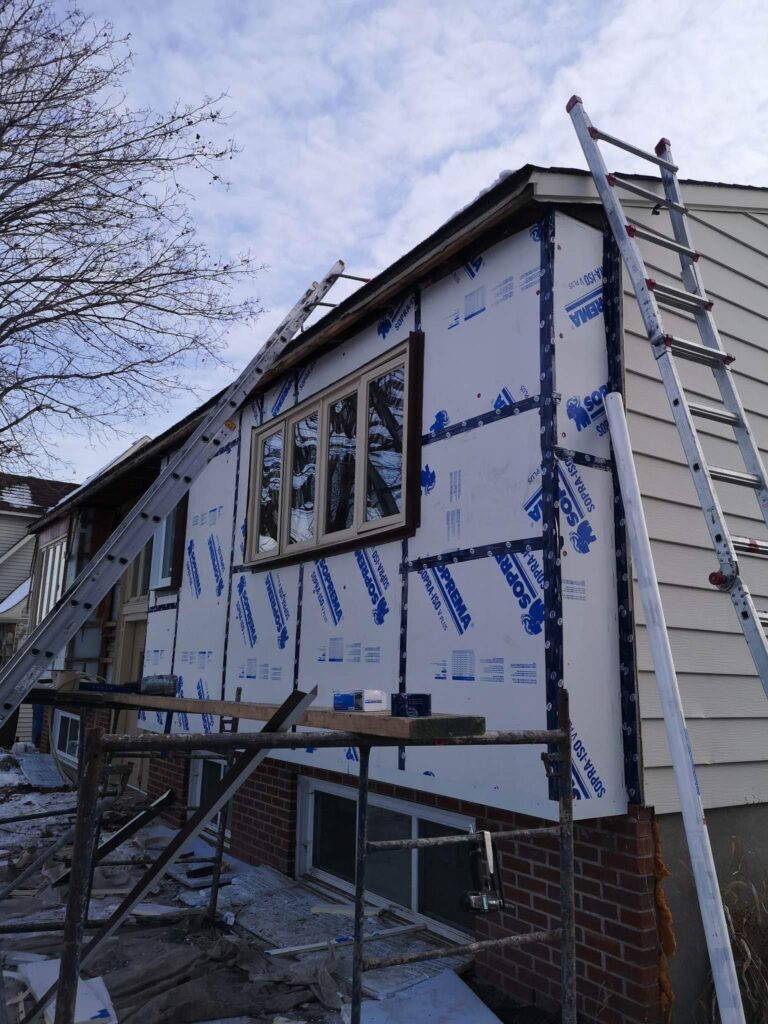
Exterior insulation consists of installing a continuous layer of insulation on the outside face of the walls, beneath the siding. It is not a finish: it is a modification to the building envelope. Gouttières et Revêtements Synergy, in Lavaltrie, installs it during siding replacement, because that is the only time the wall is accessible from that side.
Insulating from the inside or the outside
From the inside, insulation is installed between the framing studs. It stops at every stud, plate and rim joist. Wood allows heat to pass through more quickly than the insulation around it. Accessing it requires removing drywall, trim and electrical boxes, and emptying the rooms.
From the outside, insulation runs over the framing without interruption. The interior finish remains intact, the home remains livable and room dimensions do not change. The constraint moves outside: the wall becomes thicker, so window and door trim, flashing and ventilation outlets must accommodate the new thickness. It is detailed work that needs to be planned, not an obstacle.
Thermal bridging, in practical terms
A thermal bridge is a location in an assembly where heat escapes more quickly than through the rest of the wall. Studs, corners, opening headers and the rim joist are all examples. Batt insulation can be installed perfectly: it goes between these components, never over them.
The result can sometimes be seen from indoors: vertical dust streaks appear along the studs, where the surface is colder. A continuous exterior layer covers the entire framing. It does not eliminate every thermal bridge—fasteners and certain penetrations still pass through the insulation—but it addresses the main source: the framing.
Why it is done during siding replacement
Installing continuous insulation requires exposing the wall: siding, trim, flashing and accessories must be removed. No one removes new siding to add insulation. When the siding has reached the end of its service life, however, the scaffolding is already up and the substrate is visible. The opportunity comes once per generation of siding.
It is also the only time the substrate can be checked: warped panels, rotted lower walls, torn membrane and corroded fasteners. These defects are corrected before the insulation covers them.
Comfort and condensation
Comfort depends not only on air temperature, but also on the temperature of the surfaces around you. A cold wall draws heat from your body through radiation: the thermostat shows the right temperature, yet you feel cold near the north wall. By warming the interior face of the wall, exterior insulation reduces this difference.
Condensation follows the same logic. Indoor air carries moisture. When that air reaches a surface that is cold enough, water is deposited. In a wall insulated only between the studs, the framing and sheathing remain cold: that is where vapour condenses if it passes through. Adding insulation over top warms the sheathing. The dew point moves outward, into a layer designed to tolerate water and dry.
What exterior insulation does not solve
It does not replace ventilation. An inefficient bathroom fan, a poorly connected dryer or a continuously damp basement will still send vapour into the home. It also does not correct attic ventilation, which is a separate system.
It does not dry a wall that is already wet. An active leak, rot or mould must be addressed first; otherwise, it is enclosed. Nor does it compensate for gutters that overflow onto the wall: that water always returns to the assembly.
How we proceed
Survey of the siding and openings. Complete removal, substrate inspection and repair of affected areas. Installation of the air- and water-management membrane, followed by continuous insulation board with treated joints. Furring strips fastened through the insulation into the framing, reworking of trim, flashing and caulking, then siding installation. Soffits, fascias and gutter connections are checked again: the wall thickness has changed.
Our Service Area
Gouttières et Revêtements Synergy is based at 580 Chem. de Lavaltrie, local 103, Lavaltrie QC J5T 0H1. We hold RBQ licence 5723-4940-01, are Alu-Rex ÉLITE Installer, CAA-Québec Recommended and APCHQ Certified. We serve Lanaudière, the Laurentides, the North Shore, Laval and Montreal.