
Soffits and fascias
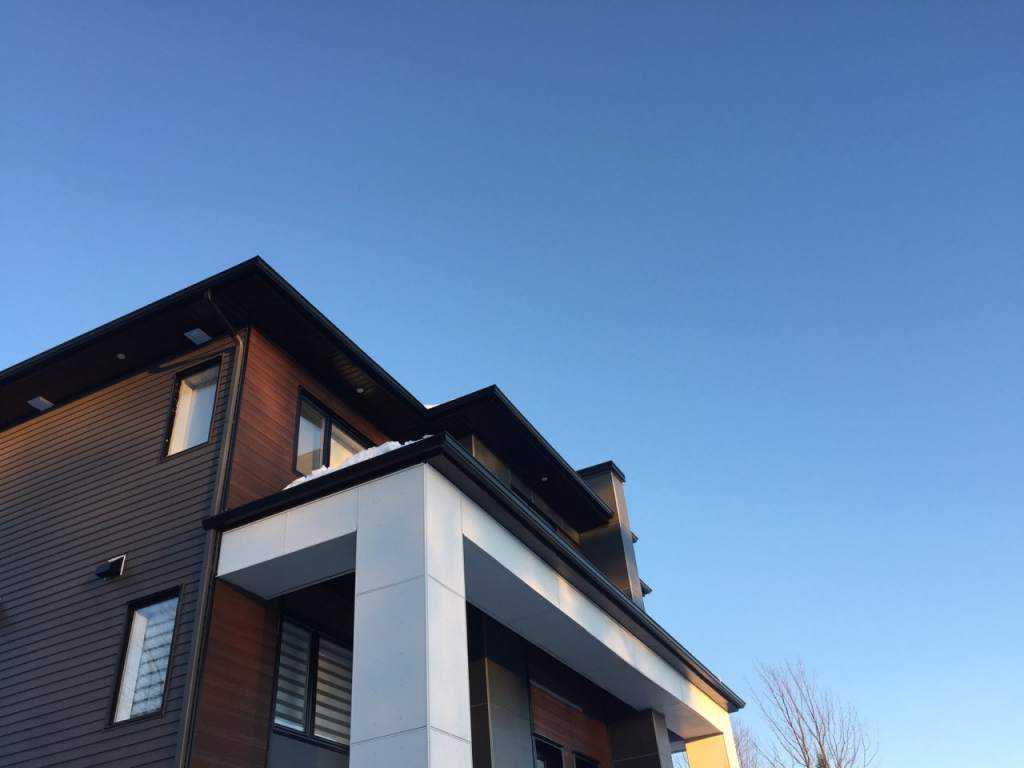
Soffit and fascia are the two components people notice the least, yet they do the most work. The soffit closes off the underside of the roof overhang and provides the air intake for attic ventilation. The fascia closes off the roof edge and supports the gutter. When either one fails, the problem does not show up where it started: it appears as ice along the roof edge, a gutter pulling away, or blackened wood. Gouttières et Revêtements Synergy works on both of these components throughout Lanaudière, the Laurentides, the North Shore, Laval and Montréal.
The soffit is the attic’s air intake
Attic ventilation is not simply a series of holes. It is a pathway. Cold air enters from below, travels through the attic and exits through the upper roof vents. Perforated soffit is the entry point for that pathway. Without an intake, the upper vents remove almost nothing: the air leaving is not replaced, and circulation stops.
Three situations block this intake. The soffit is solid rather than perforated. It is perforated, but blocked from the inside by insulation pushed all the way to the overhang. Or it is missing, torn off or damaged. In all three cases, the result is the same: the attic does not cool down.
A warm attic melts snow from underneath. Meltwater runs down to the roof overhang, which does not extend over heated space and remains cold. It refreezes there and forms a dam. This is how an ice dam forms, and it begins at the air intake.
The fascia closes off the roof edge and supports the gutter
The fascia closes off the roof edge, at the ends of the rafters. It holds the edge of the roofing material in place and blocks direct access to the attic by water, birds and insects. It also has a mechanical function: it is where the gutter fasteners are installed.
That second function changes everything. An empty gutter is light. A gutter full of water, packed snow or ice is not, and that entire load is carried by screws fastened into the fascia board. Rotten wood cannot hold a screw. The section tilts, pulls away from the wall, then lets go—and the gutter is not to blame. During gutter installation, the condition of the fascia board is checked before drilling.
What you can see from the ground
Most warning signs can be spotted from the ground, without climbing up.
- A hanging, dislodged or missing soffit panel: the overhang is no longer enclosed.
- Dark stains or discolouration on the soffit: water is reaching the overhang from the roof or gutter higher up.
- Birds, wasps or squirrels repeatedly going in and out of the overhang: there is an opening in the soffit or where it meets the fascia.
- Blistering paint, split wood or a dark strip along the fascia: the wood is taking on water.
- A wavy gutter line or a section pulling away from the wall: the fasteners are no longer holding in the fascia.
- Aluminum cladding that is bulging or marked by rust streaks at the nails: what is behind it is moving or swelling.
- Ice forming in the same spot on the overhang every winter: the air intake there is probably blocked.
What new soffit does not fix
We need to be clear about the limitations; otherwise, it is a false repair.
New soffit does not correct inadequate attic insulation. It restores the air intake, which is necessary, but heat rising from the heated ceiling will continue to rise. The source must also be addressed: see exterior insulation.
New perforated soffit accomplishes nothing if insulation remains pushed against the overhang inside the attic. Air enters through the perforations and hits a wall of insulation. The insulation must be held back so that the passage is genuinely open.
And covering rotten fascia with aluminum does not make it sound again. Metal hides the wood; it does not dry it out or restore its ability to hold a screw. The rot continues out of sight, with a loaded gutter hanging from it. Damaged wood must be replaced before cladding, not after.
Aluminum at the roof overhang
We finish roof overhangs in aluminum: perforated soffit panels for air intake, solid panels elsewhere, and sheet metal bent to the fascia profile. Aluminum does not rot and does not require maintenance painting. It is a protective cladding, not a structural component: it protects the wood, provided that the wood is sound at the time of installation.
Our company
Gouttières et Revêtements Synergy holds RBQ licence 5723-4940-01, is an Alu-Rex ÉLITE Installer, is recommended by CAA-Québec and is APCHQ certified. Our offices are located at 580 Chem. de Lavaltrie, Suite 103, Lavaltrie.