It is heavy
A fiber cement board weighs much more than a vinyl board of the same surface area. This shows up everywhere: two-person handling, scaffolding rather than ladders, and a slower installation pace. The weight adds time to the project.

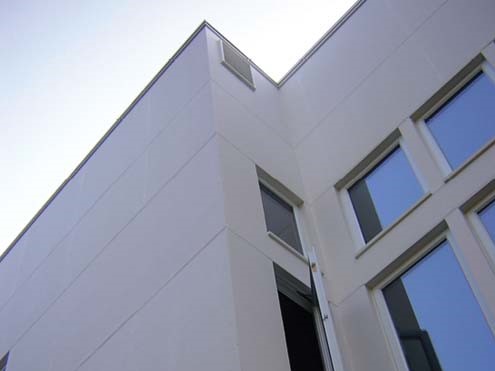
Fiber cement is a composite made of cement, sand, and fibers, pressed and molded into lap siding boards, panels, trim, and finishing pieces. It is neither wood nor plastic, and it does not behave like either one. It is highly stable through changes in temperature and humidity, provides no food source for insects, and does not burn like a wood board. In return, it is heavy, cutting it produces dust that requires precautions, and it places specific demands on the structure, fastening, and joint sealing. Gouttières et Revêtements Synergy installs fiber cement siding in Lanaudière, the Laurentides, the North Shore, Laval, and Montreal. RBQ license 5723-4940-01.
The fibers reinforce the cement matrix, giving the product strength without making it brittle like a slab. The result is dense and rigid. A fiber cement board cannot be bent by hand, will not warp in the sun, and will not shrink in the cold as a wood board or vinyl profile would.
The product is available factory-painted or primed for painting on site, with a smooth or textured surface that imitates wood grain. The factory finish is applied to a material that barely moves: this stability of the substrate is what explains the paint’s durability.
In our climate, a wall goes from damp freezing conditions to summer heat and repeats the cycle every year. Materials that swell and shrink at that pace open up their joints and put stress on their fasteners. Fiber cement moves very little: joints remain more or less where they were installed, and sealant is not stretched and compressed with every season.
It does not rot either, because there is no solid wood to decompose. A wet panel dries and returns to what it was. That does not make the wall watertight, however: water that gets behind the siding must still be able to drain downward and exit through a ventilated air gap, just as it must with any other material.
Carpenter ants and wood-boring insects look for wood, preferably damp wood. Fiber cement offers them nothing to eat and nothing to tunnel through. The distinction matters: they can still establish themselves in the framing lumber or in a waterlogged substrate behind the siding. The surface material removes a food source; it does not solve a water intrusion problem.
When it comes to fire, fiber cement does not ignite like cedar or pine. An ember landing on this type of wall does not find the fuel it would find on wood lap siding.
A fiber cement board weighs much more than a vinyl board of the same surface area. This shows up everywhere: two-person handling, scaffolding rather than ladders, and a slower installation pace. The weight adds time to the project.
Cutting fiber cement releases fine mineral dust that must not be inhaled. The work site uses blades designed for this material, source dust collection or wet cutting, and respiratory protection. This is not an optional precaution.
The wall carries a greater load than it would with lightweight siding. The substrate and framing are checked once the old siding has been removed. A soft, delaminated, or water-damaged substrate is replaced before installation, never afterward.
Fasteners must reach the structure, not just the sheathing, and they must be driven neither too deep nor left proud. A nail driven too deeply crushes the material and starts a crack; a nail that does not reach the structure allows the board to move in the wind.
This is where a fiber cement siding installation is judged. Every cut made on site exposes a raw edge that does not have the factory finish. Board ends, corner trim, and the perimeters of openings must be treated: edges sealed, proper clearance maintained, flashing installed where the wall requires it, then caulking applied between dissimilar materials.
A sealant joint remains a wear item. It moves, dries out, and will eventually need to be redone. It replaces neither flashing nor the weather-resistive barrier. A wall that relies on its caulking to stay dry is a poorly assembled wall, regardless of the siding installed over it.
Fiber cement benefits particularly from a ventilated air gap, which allows its back side to dry.
Fiber cement is not the right choice everywhere. If minimum weight, fast installation, or no long-term painting is the priority, other materials are better suited — see our full exterior siding comparison. We will tell you on site what your wall can support.
Gouttières et Revêtements Synergy is based at 580 Chem. de Lavaltrie, local 103, Lavaltrie QC J5T 0H1. We hold RBQ licence 5723-4940-01, are Alu-Rex ÉLITE Installer, CAA-Québec Recommended and APCHQ Certified. We serve Lanaudière, the Laurentides, the North Shore, Laval and Montreal. We evaluate your wall on site before recommending a material or sequence of work.