
Steel Exterior Siding | Sales & Installation
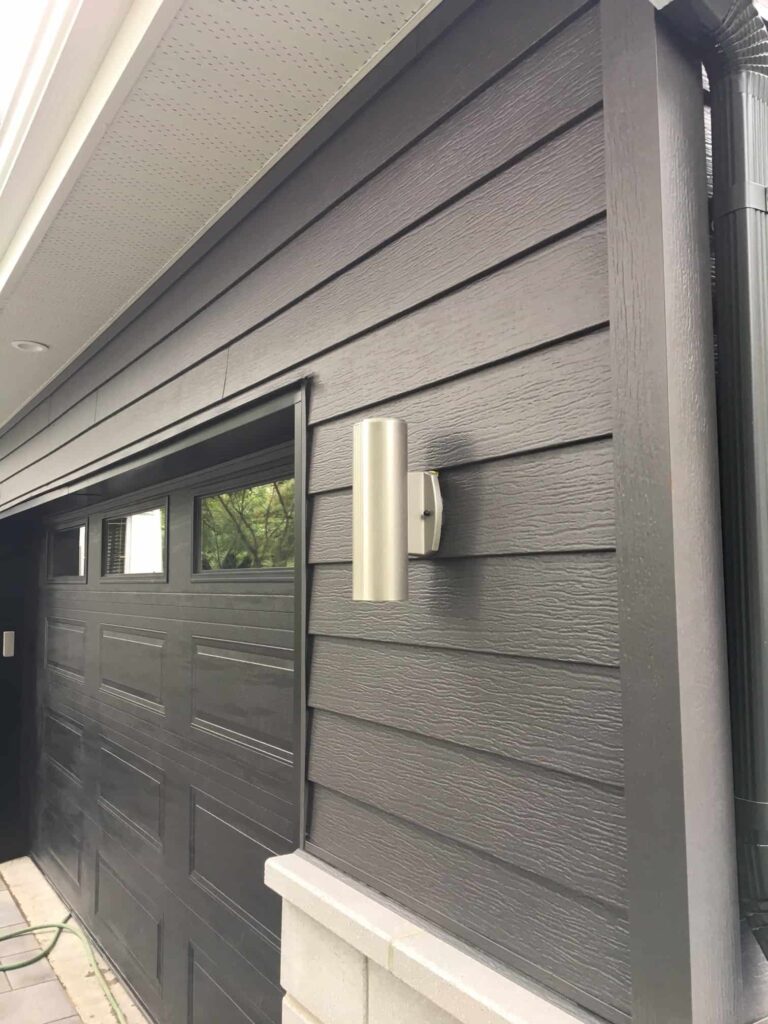
Steel exterior siding is cold-formed, galvanized sheet metal that is factory-painted with a baked-on coating. It can be installed as horizontal lap siding, vertical boards, or panels over furring strips fastened to the wall. This is the material we propose when a façade takes impacts, wind carrying debris, or hail, and when the owner wants a surface that does not become brittle in winter. This page explains what steel siding does well and where its limits are.
Steel Does Not Become Brittle in Cold Weather
This is the most practical difference between steel siding and vinyl. A vinyl panel loses flexibility in cold weather: a slipping ladder, a shovel, or ice falling from the roof can make it crack instead of bend. Steel remains ductile. It takes an impact by deforming without shattering or splitting.
That same rigidity also helps in wind. Steel siding boards do not rattle or lift. The factory-baked finish does not deteriorate through freeze-thaw cycles because it is applied to the metal at the factory, not painted on site.
Three Trade-Offs to State Clearly
It Can Dent
A strong impact leaves a permanent dent. A ball strike, branch, or car door can leave a visible mark that cannot be pushed back from the outside. The correction is to replace the affected board, not repair it.
Every Cut Exposes Steel
Galvanizing and the coating protect the faces of the siding, not its thickness. A board cut on site has an exposed edge where corrosion can begin. That edge must be concealed inside a trim piece, directed downward, or protected with the manufacturer’s touch-up product.
It Expands and Contracts
Metal lengthens in sunlight and contracts in cold weather. A board fastened too tightly has nowhere to move and can buckle between fasteners. The required clearance has to be planned during steel siding installation, not after the wall is finished.
What Installation Must Account For
Expansion Clearance
Fasteners must be placed in the centre of the oval slots without crushing the board. Clearance is also needed at the ends where the siding meets trim pieces.
Cutting Methods
Steel must be cut with shears or a blade intended for metal. An abrasive grinder burns the finish and throws hot metal filings onto the painted face. Once those filings stick to the surface, they can rust there.
Contact Between Different Metals
Two dissimilar metals in contact in moisture can corrode. Fasteners, flashing, and trim must therefore be selected accordingly, or the metals must be separated.
Drainage Behind the Wall
Water that gets behind the siding must be able to drain down and out through the wall assembly. Membrane, furring strips, and flashing handle this work; the sheet metal itself does not.
Steel Siding vs Aluminum
| Criteria | Steel | Aluminum |
|---|---|---|
| Impact | Resists impacts better; dents under a strong blow | Softer and marks more easily |
| Corrosion | Cut edges and deep scratches must be protected | Does not rust, even when cut |
| Rigidity | Stiffer boards that are heavier to handle | Lightweight and easy to work around openings |
| Finish | Baked coating on galvanized metal | Can become chalky under UV exposure over time |
For owners comparing steel siding vs aluminum siding, the choice depends on the wall’s exposure, the risk of impacts, the condition behind the existing siding, drainage, and what roof water does around the building. Questions about steel siding cost or metal siding cost per square foot should be considered with those conditions rather than separately from the wall assessment. Vinyl, fiber cement, wood, Maibec, and CanExel are also available — see the full comparison on our exterior siding page.
Maintenance and Repair
Steel siding is not painted or stained on site. Maintenance is limited to rinsing exposed surfaces affected by road dust and salt, and touching up scratches that go through the coating to the metal. A dented or punctured board can be replaced individually when the rest of the wall is sound.
Keep extra boards in the original colour after the project. Colours can vary from one production run to another. For homeowners searching for steel siding near me in Laval, Montréal, the West Island, or the North Shore, this practical detail matters when a single board needs replacement later.
Wall Assessment Before Material Selection
We assess the wall before proposing a material: exposure, the condition of the substrate beneath the old siding, whether drainage is present behind the wall, and what the roof water does. These conditions determine whether steel siding is appropriate and what the installation must include. To discuss your project, request a free quote or call 450-559-5648.
Gouttières et Revêtements Synergy holds RBQ license 5723-4940-01, is an Alu-Rex ÉLITE certified installer, recommended by CAA-Québec, and APCHQ certified. Our teams operate from 580 Chem. de Lavaltrie, local 103, Lavaltrie, QC J5T 0H1, and serve Lanaudière, the Laurentians, the North Shore (Rive-Nord), Laval, and Montreal. Phone: 450-559-5648.