Pollen
A uniform yellow film in spring, more noticeable on sides exposed to the prevailing wind. It rinses off easily and says nothing about the condition of the wall, other than that there are flowering trees nearby.

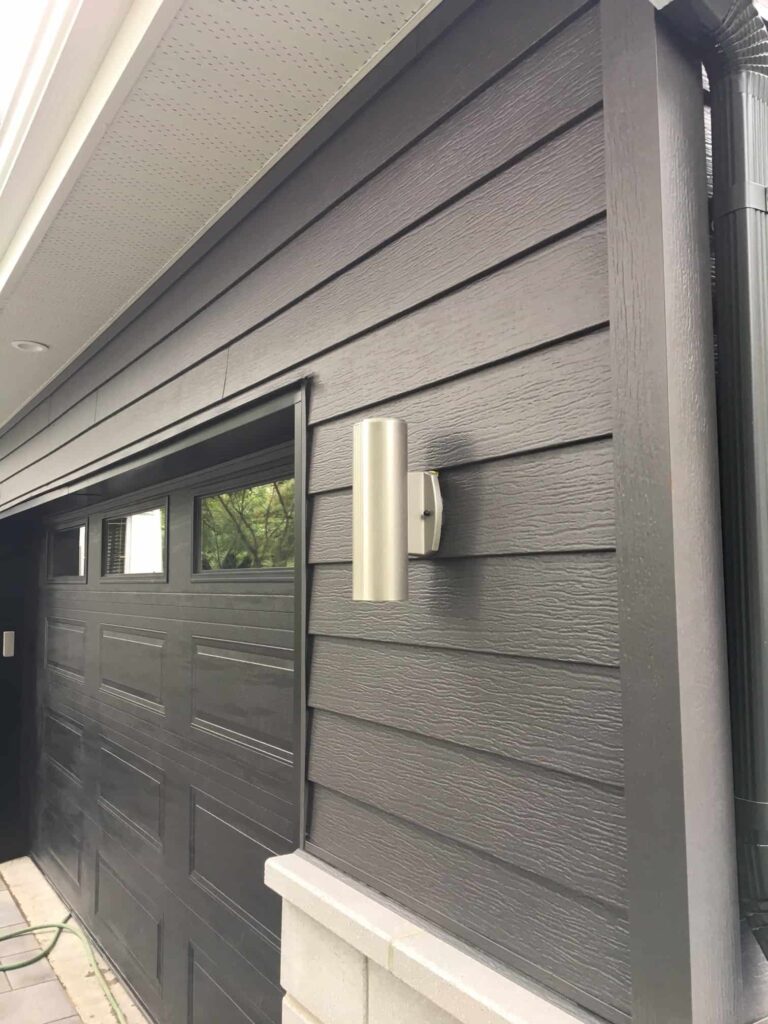
A dirty wall is not just an appearance issue. What collects on exterior siding tells a story about what is happening around the house—and sometimes behind the wall. Grime spread evenly across an entire façade does not mean the same thing as a stain that keeps returning to the same spot. The first calls for washing. The second calls for correction. We assess before bringing out the hose.
Four types of deposits commonly appear on homes in Lanaudière and the North Shore. Each has its own cause.
A uniform yellow film in spring, more noticeable on sides exposed to the prevailing wind. It rinses off easily and says nothing about the condition of the wall, other than that there are flowering trees nearby.
A grey band along the bottom of the wall, especially near streets that are sanded in winter and gravel driveways. It rises through splashback. If it stops abruptly at a consistent height, rain is bouncing off the ground or a slab.
On the north side, beneath trees, or behind a hedge. They develop where the wall does not dry well because of limited sun and air circulation. Washing removes the deposit; it does not change the conditions. Clearing vegetation away from the wall slows its return.
Dark vertical streaks that all start at the same point, below a joint, corner, or outlet. This is not dirt carried by the wind: it is debris-laden water that has overflowed.
A vertical streak that reappears in the same location after every heavy rainfall means water is leaving the gutter at that specific point. Common causes include a clogged trough, an open joint, a slope that does not direct water toward the outlet, a blocked downspout, or a gutter that is too narrow for the roof area it drains.
Washing the mark makes it disappear for a while. It comes back. Meanwhile, overflowing water does more than make the wall dirty: it wets the fascia, runs behind the gutter, and saturates the bottom of the wall. The proper order is to fix the source (gutter cleaning or repair), then wash.
Exterior siding is not watertight, nor does it need to be. It is installed in overlapping courses: each row overlaps the one below it, so water running down the face flows out. Behind it, a weather-resistive barrier does the actual waterproofing work, often with an air gap that drains and allows drying.
A spray directed upward, or straight into a vertical joint, gets beneath the overlap and forces water in from the wrong side. That water does not drain out like rain: it wets the sheathing, the membrane, and the insulation, then dries slowly. The damage appears much later—a stain indoors, a warped panel, an odour. The same spray can loosen window caulking, enter through vents and outlets, mark vinyl, and saturate the cut edges of a fibreboard panel. Dirt does not penetrate a wall.
The rule is simple: the spray follows the path rainwater already takes. Work from top to bottom, with the nozzle aimed downward and toward the face of the siding, never slipped beneath a course. Use moderate pressure and a wide fan nozzle: it is the cleaning product and contact time that loosen deposits, not force. A soft brush handles stubborn areas better than a stronger spray.
Before starting: close windows, protect outlets and light fixtures, and wet the vegetation. Also inspect the wall—we do not wash a wall with cracked caulking or a cracked panel, as that would inject water exactly where it should not go. Repair first, then wash.
Vinyl faded by UV exposure will not regain its colour. Chalking aluminum loses its powder when washed, but the paint underneath remains worn. A wood or fibreboard panel with an open finish will continue to absorb moisture through its edges: that calls for refinishing or replacement. A wall constantly sprayed by an overflowing gutter will remain dirty, no matter how many times it is washed. When that is the case, we say so rather than sell a washing service that will need to be repeated. Every exterior siding material has its own maintenance limitations.
Gouttières et Revêtements Synergy is based at 580 Chem. de Lavaltrie, local 103, Lavaltrie QC J5T 0H1. We hold RBQ licence 5723-4940-01, are Alu-Rex ÉLITE Installer, CAA-Québec Recommended and APCHQ Certified. We serve Lanaudière, the Laurentides, the North Shore, Laval and Montreal.