
Gutter Repairs | Diagnosis & Section Replacement
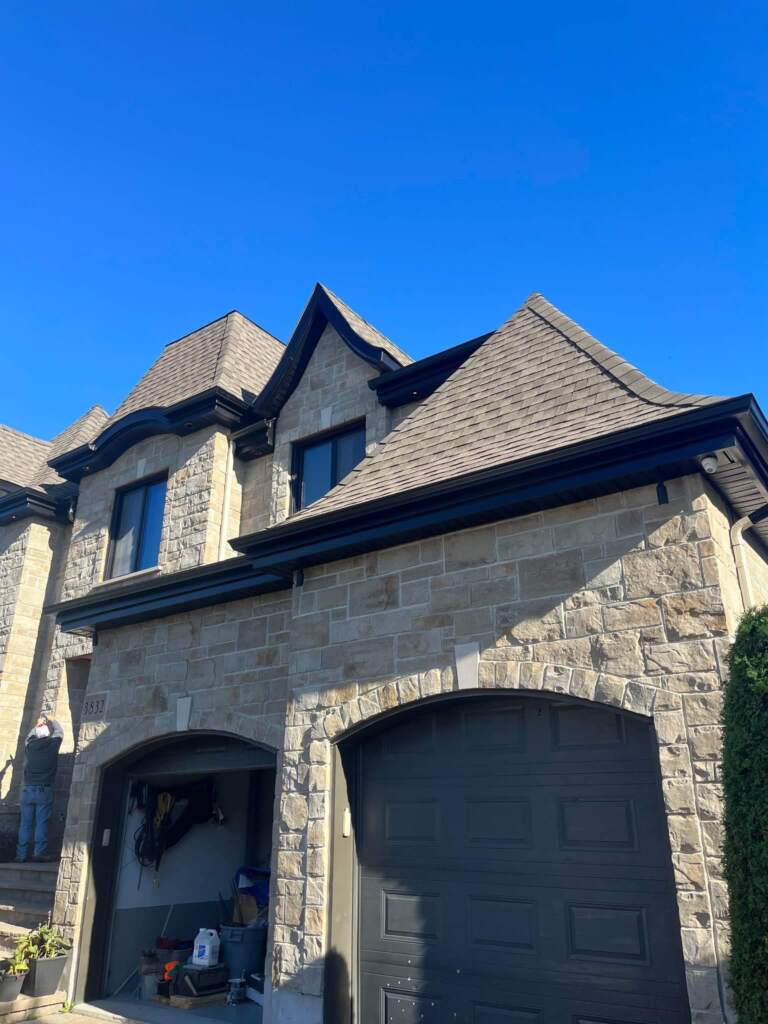
A leaking gutter almost never reveals the exact location of the defect. Water follows the slope, runs along the bottom of the profile, then falls at the first obstruction. Sealing the point where it drips without looking farther upstream only masks a symptom while the cause continues to worsen. Our method starts with the symptom, traces it back to the mechanical failure, then determines whether a targeted repair or section replacement is needed. Gouttières et Revêtements Synergy holds RBQ licence 5723-4940-01 and serves Lanaudière, the Laurentides, the North Shore, Laval, and Montreal.
Read the symptom before going up
Three distinct signs guide the diagnosis. Each points to a different family of causes, and therefore a different repair.
Water spills over the edge
Always in the same spot: reverse slope, accumulated debris, or a clogged downspout. Across the entire length during heavy rainfall: it is not a leak, but a volume of water the gutter cannot drain.
A localized drip
A single, steady drip, always at the same point, indicates an open joint, a worn rivet, or an enlarged screw hole. This is the most repairable situation, provided the surrounding metal is still sound.
A water mark behind the gutter
Water running between the gutter profile and the wall wets the fascia, then the soffit. The issue is upstream: a roof edge without drip edge flashing, a membrane that is too short, or a gutter installed too low.
Failed fasteners
A section that sags or pulls away from the wall has lost its anchor points. The screw may have enlarged its hole in the aluminum, or the fascia wood may be too soft to hold anything. Putting a screw back into rotten fascia will not hold. We probe the wood before reinstalling a fastener. When it is softened over a length, the gutter becomes secondary: the roof edge must be addressed first.
Leaking joints
Aluminum expands and contracts with every temperature cycle. A rigid joint eventually fatigues, and the sealant covering it cracks. Proper resealing—stripped surface, old product removed, joint rebuilt—solves the problem when both sections are still aligned. If they are no longer aligned, sealant will only delay the next leak. On a seamless gutter, a leak along the middle of a run generally indicates a puncture or fatigue crack.
Sections deformed by ice or a ladder
The weight of ice and snow pulls downward and outward: the profile opens up and no longer holds water across its full width. A ladder leaned directly against the edge causes the same crushing, but in a more localized area. Deformed aluminum does not return to its original shape: straightening it creates creases that weaken the metal and become leak points. With a short deformation, it may sometimes be possible to live with it. Not when the deformation disrupts the slope.
Slope lost through sagging
A gutter must drain toward its downspout. When a fastener fails midway along the run, the profile sags and creates a low spot where water collects. Standing water attracts debris, adds weight to the section, and accelerates the loss of slope: the problem worsens on its own. The correction involves restoring alignment point by point, not simply tightening the faulty screw. Water that remains standing after a repair means the slope has not been restored.
Detached downspout outlets
The outlet is the most heavily stressed point: all the water from the section converges there. The joint between the gutter and the elbow works with every rainfall and every freeze. When it comes apart, water falls directly at the base of the wall, often near the foundation. We rebuild the assembly, review the anchoring of the vertical sections, and verify that the discharge truly carries water away from the building.
When repair is no longer cost-effective
There comes a point when repairing costs more than replacing, and we say so plainly. Multiple leak points along the same run, aluminum thinned or perforated by corrosion, a profile deformed over several linear feet, joints repeatedly resealed: in these cases, replacing the section is the only solution that will last. If the gutter receives more water than it can drain, no repair will change that: the size or number of downspouts must be reconsidered. We are an Alu-Rex ÉLITE installer, recommended by CAA-Québec, and APCHQ certified, and we would rather decline a repair than charge for it twice.
Replace the section
When the metal or slope can no longer be restored, we install a new section over the affected length, securing it with anchors in sound wood.
Review the drainage
Chronic overflow is resolved through drainage: the downspout route, discharge points, or a larger gutter size.
Have it assessed before deciding
A repair must be planned on site, not based on a description over the phone. We go up, document every defect, and distinguish what can be repaired from what needs to be replaced.
Our Service Area
Gouttières et Revêtements Synergy is based at 580 Chem. de Lavaltrie, local 103, Lavaltrie QC J5T 0H1. We hold RBQ licence 5723-4940-01, are Alu-Rex ÉLITE Installer, CAA-Québec Recommended and APCHQ Certified. We serve Lanaudière, the Laurentides, the North Shore, Laval and Montreal.