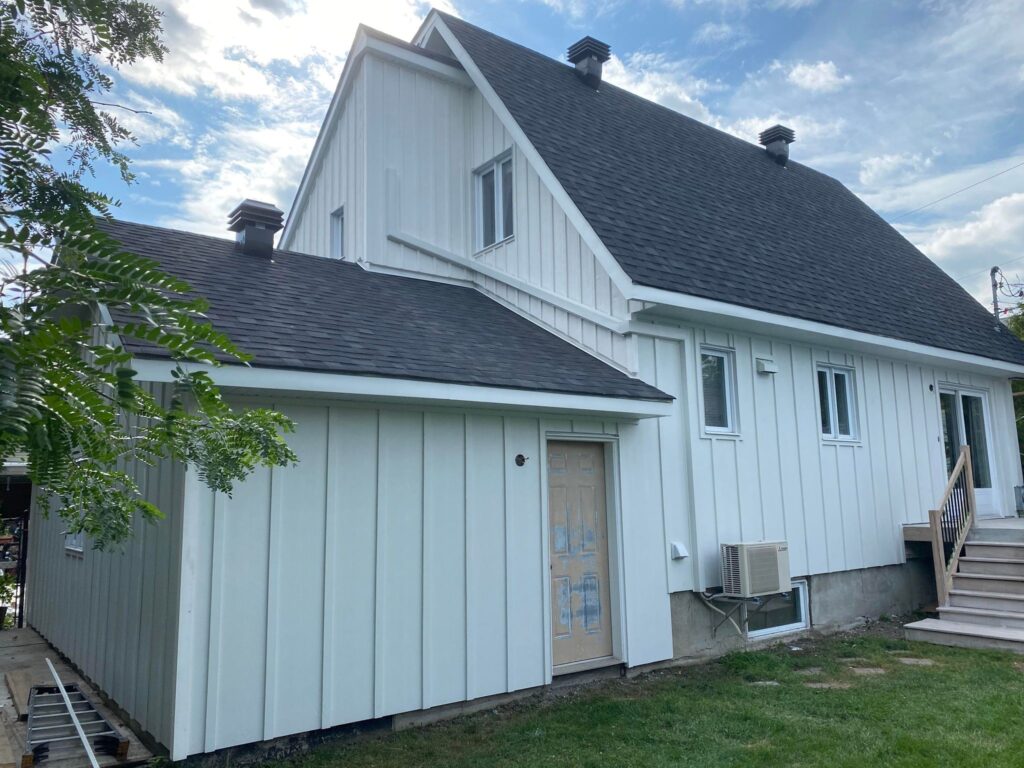
A gutter only works when it is clear. As soon as a layer of debris settles at the bottom of the trough, water stops following its intended path: it pools, overflows the edge, runs down the exterior cladding, and collects at the foundation. Cleaning is not a cosmetic service. It is mechanical maintenance for a component that must remain unobstructed to function.
What builds up depends on the trees nearby
There is no universal schedule. A home surrounded by mature maples and a home on an open lot do not collect debris at the same rate or of the same kind. The tree species around the building and their distance from it determine what accumulates.
Broad leaves
Maples, ash trees, poplars. Their leaves fall in batches over a short period in the fall. When wet, they stick together and form a compact mat that holds water like a sponge. As they decompose, they become growing medium where shoots germinate at the bottom of the trough.
Conifer needles
Spruce, pine, cedar. They fall year-round in small, continuous amounts. Fine and rigid, they pass through wide-mesh gutter guards and interlock into a felt-like mat just above the downspout outlet.
Maple seeds
Samaras arrive in large quantities in the spring and travel far from the tree trunk. Light while airborne, they become saturated with water once inside the trough. They lodge in the downspout outlet and form a blockage that cannot be seen from the ground.
Shingle granules
A dark, sandy deposit at the bottom of the trough. It is not dirt from the ground: it is mineral granules released from the surface of asphalt shingles and carried down by the rain.
Granules say something about the roof, not the gutter
The granule layer on an asphalt shingle protects the bitumen from the sun. When the surface becomes bare, the exposed bitumen dries out, hardens, and then cracks. A newly installed roof sheds some loose granules, which is normal. Finding a sandy layer after cleaning time and time again is different: the surface is wearing down.
To be clear, cleaning the gutter does not slow this wear. Cleaning provides information that no one would otherwise look for, because it requires a close look at what is coming off the roof. It offers the same perspective as a gutter inspection, where the condition of the joints, fasteners, and fascia is also noted.
In winter, a full gutter becomes a solid block
Saturated debris does not drain. The water it holds freezes in place and expands as it freezes. The mass pushes outward against the trough and pulls downward. That weight is not distributed evenly: it is concentrated at the attachment points, on the hangers and screws fastened into the fascia.
The fascia, meanwhile, has spent the fall receiving overflow water. A fastener held in softened wood eventually gives way. The gutter tilts, a section drops out of line, and meltwater spills in the wrong place, often behind the gutter, against the fascia and soffit. Each freeze-thaw cycle repeats the process on already weakened fasteners.
Doing it yourself: what actually causes injuries
The risk is not the gutter; it is the ladder. It rests on ground that is rarely level or firm: loose soil, mulch, a sloped yard, or an angled slab. Leaned directly against the trough, it crushes the aluminum and distorts the gutter line.
The dangerous move is always the same: reaching sideways to cover one more section instead of climbing down and moving the ladder. Your body moves outside the ladder rails, and the whole setup tips. Add wet gloves, a bucket, slippery debris, and the hose that must be brought up to check the flow. A fall from that height can cause serious injury on hard ground, often with no one nearby.
What cleaning fixes, and what it does not
What it fixes
Debris is removed from the trough, the outlet and inside of the downspouts are cleared, flow resumes toward the outlets, and rinsing confirms that the water is getting through. Overflow caused by a blockage disappears.
What it does not fix
Insufficient slope toward the outlet, a trough that is too narrow for the roof area it drains, an undersized downspout, or an open joint. These problems return with the next heavy rainfall and require gutter repair.
Gutter guards reduce maintenance; they do not eliminate it
A properly installed gutter guard stops broad leaves and samaras before they enter. That is the main benefit. No system is completely sealed against fine needles and granules: what gets through is smaller, moves more easily, and clogs less quickly, but inspections are still necessary. Anyone promising the end of all maintenance is selling something else.
One precaution: installing a gutter guard over a dirty gutter traps debris underneath. The trough must be cleared first; installation comes afterward. We are an Alu-Rex ÉLITE installer.
Our Service Area
Gouttières et Revêtements Synergy is based at 580 Chem. de Lavaltrie, local 103, Lavaltrie QC J5T 0H1. We hold RBQ licence 5723-4940-01, are Alu-Rex ÉLITE Installer, CAA-Québec Recommended and APCHQ Certified. We serve Lanaudière, the Laurentides, the North Shore, Laval and Montreal.
Get My Free Quote Call 450-559-5648