An overflowing gutter does not explain why it is overflowing. An inspection identifies the cause before you pay for a fix that will not actually solve it. Gouttières et Revêtements Synergy examines the entire system: the gutter’s actual slope, fasteners, fascia, joints, outlets, downspouts, and discharge point at ground level. We serve Lanaudière, the Laurentides, the North Shore, Laval, and Montreal.
The actual slope, not the assumed slope
A gutter must carry water to an outlet. When it no longer does, the channel shows it: a strip of sediment at the bottom, a deposit ring, sometimes moss. These are the places where water remains after rain. We check the slope section by section with a level and note where water actually collects rather than where it should be going. A section that has sagged between two supports creates a belly: it holds water, gains weight, and pulls even harder on its fasteners. The problem worsens on its own.
Fasteners and fascia
The brackets hold the gutter, but the fascia holds the brackets. We inspect every fastener: looseness, screws spinning freely, bent brackets, and gutters pulling away from the wall. Then we probe the wood behind them. Fascia softened by prolonged runoff no longer holds anything, and installing a new gutter on that wood only provides a temporary reprieve. The sequence is then clear: repair the fascia first, reinstall afterward. Water marks on a soffit or stained wood also add to the picture.
Joints, corners, and outlets
Leaks almost always return to the same places: section joints, inside and outside corners, end caps, and the outlet opening to the downspout. Hardened sealant cracks and lets a trickle through, often unnoticed in dry weather. An outlet partially blocked by compacted needles can make the entire gutter overflow upstream, even if the gutter is clean elsewhere. We open it, clear it, and watch the water flow. Some of these defects can be repaired locally.
Downspouts and ground-level drainage
A perfect gutter is useless if its downspout discharges water against the foundation. We follow the pipe: wall fasteners, elbows facing the right direction, separated sections, and above all, the discharge point. The ground speaks for itself. Eroded soil, washed-out backfill, splash marks on the lower wall, darker grass: water leaves evidence of where it lands. A discharge point too close to the foundation requires an extension or relocation of the downspout. When a single outlet receives water from a large roof slope, the gutter overflows before the water has time to go down.
What the siding reveals
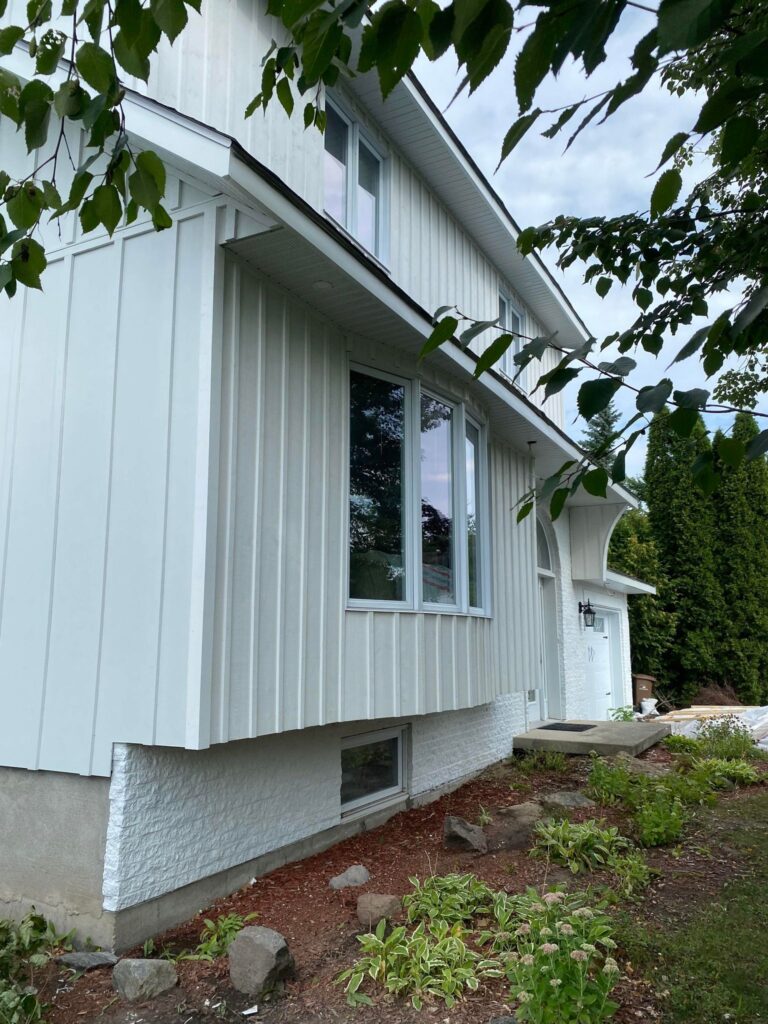
Vertical streaks below a joint, a dark mark on the siding, warped vinyl, stained capping below a corner: these marks often reveal the exact location of a leak that cannot be seen from above. We read them before climbing up. Exterior siding marked by repeated runoff should also be checked underneath, where water may have entered.
Granules in the gutter
Asphalt granules at the bottom of a gutter come from the shingles. A light deposit after a new roof is installed corresponds to excess installation granules washing away. A heavy deposit that returns every year on an older roof indicates wear in the roofing material: it is information for the roofer, not a reason to replace the gutter. We do not sell a gutter to solve a roofing problem.
From the ground or at height: who checks what
What can be checked from the ground
Step back and follow the gutter line against the roofline: a belly or a section that dips can be seen with the naked eye. Look for streaks on the siding, stains below corners, eroded soil beneath a downspout, and separated pipe sections. The most revealing time remains during heavy rain: go outside and look. Overflow that always occurs in the same spot indicates a blockage or slope issue; a trickle behind the gutter points instead to a roof-edge problem.
What requires climbing up
The bottom of the gutter channel, the play in each bracket, the condition of the fascia wood, joint sealant, and the actual opening of the outlet cannot be seen from below. Climbing requires a stable ladder, firm ground, and comfort with heights. A high wall, sloped terrain, waterlogged ground, or a steep roof is not the time to improvise. This is the part we handle.
What you know afterward
At the end, you know what can be repaired, what needs to be replaced, and why. A leaking joint, a pulled-out bracket, or a blocked outlet can be repaired. A gutter deformed along its entire length, with brackets that have torn the fascia, will not hold up for long after repair; we say so rather than work around it. Cleaning resolves a blockage, never a slope issue. A leaf guard keeps leaves out, but it does not straighten a poorly sloped gutter.
Our Service Area
Gouttières et Revêtements Synergy is based at 580 Chem. de Lavaltrie, local 103, Lavaltrie QC J5T 0H1. We hold RBQ licence 5723-4940-01, are Alu-Rex ÉLITE Installer, CAA-Québec Recommended and APCHQ Certified. We serve Lanaudière, the Laurentides, the North Shore, Laval and Montreal.
Get My Free Quote Call 450-559-5648