
Gutter installation
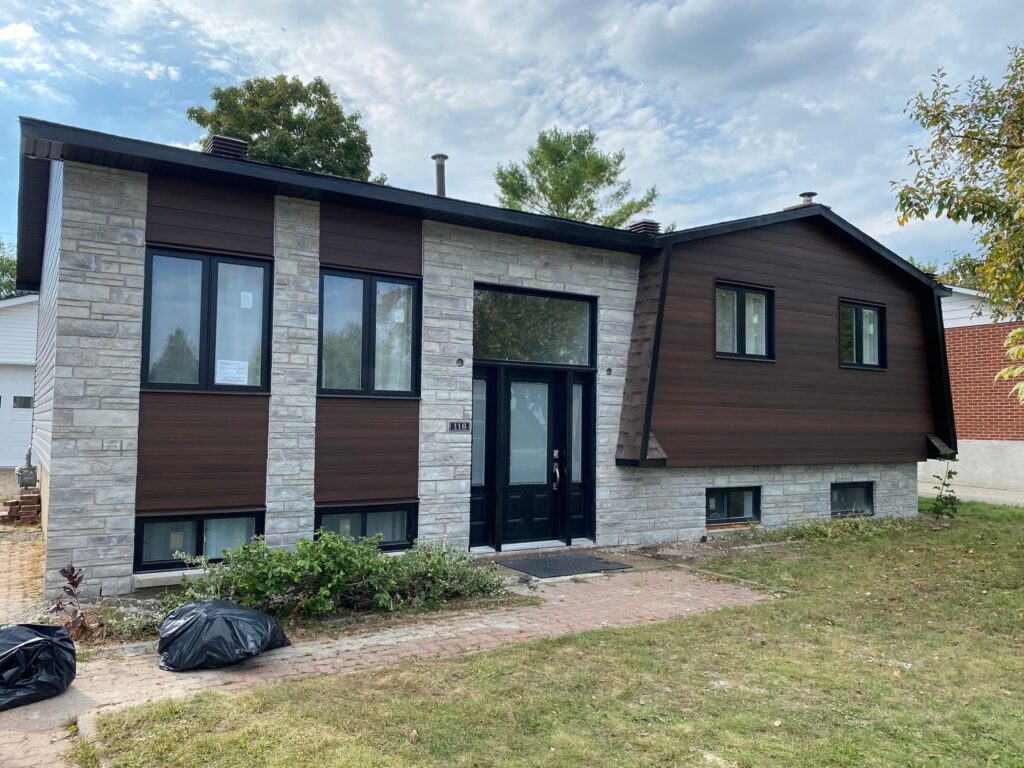
Seamless aluminum gutter installation, explained clearly
Proper seamless gutter installation starts with measuring the roof edges, checking the fascia condition, planning drainage points, and forming the gutter directly on site from aluminum coil. The main gutter run is made in one continuous length for each roof edge. Unlike older sectional gutters, it does not have joints along the run where water commonly works its way through over time.
End caps, outlets, corners, and downspout connections still require sealed connections. The difference is that the long horizontal section has far fewer potential leak points. That matters on Quebec homes, where repeated freeze-thaw cycles can stress sealant, fasteners, fascia boards, and older gutter seams.
Gouttières et Revêtements Synergy installs aluminum gutters for residential and commercial properties across Quebec. The work includes reviewing the roofline, selecting an appropriate gutter profile and capacity, setting the required drainage slope, fastening the system securely, and directing runoff through properly placed downspouts.
Choosing between 5-inch and 6-inch gutters
Both 5-inch and 6-inch gutters can be suitable, but they do not handle the same volume of water. The right choice depends on the roof area feeding each gutter run, the roof pitch, the length of the run, the number of valleys, and where downspouts can be placed.
5-inch gutters
5-inch aluminum gutters are commonly used on smaller or straightforward roof sections with manageable drainage areas. They can work well where the roofline has adequate downspout locations and water does not concentrate heavily in valleys.
6-inch gutters
6-inch gutters provide more carrying capacity. They are often considered for larger roofs, steep roof planes, long runs, roof valleys, or locations where heavy rainfall and winter snow melt can send a concentrated flow toward one section of gutter.
Quebec winters add another consideration. Snow accumulation, ice formation, and spring thaw can create high volumes of water over short periods. A larger gutter is not automatically required on every building, but capacity must match the roof drainage conditions. Installing a gutter that is too small can lead to overflow, staining, water around the foundation, and unnecessary strain on the fascia.
Slope and hanger spacing are not minor details
A gutter must slope toward its outlet so water moves instead of sitting in the channel. The slope is subtle; it should drain effectively without looking visibly crooked from the ground. If the slope is wrong, standing water can remain in the gutter after rain or thaw. That extra weight contributes to sagging, debris buildup, corrosion around connections, and ice formation during cold weather.
Hangers also need to be installed at appropriate spacing and fastened into solid backing. A gutter filled with water, wet leaves, ice, or snow is carrying significant load. Wide hanger spacing, loose fasteners, or attachment into weakened fascia can allow the gutter to pull away from the roof edge. A clean-looking installation is not enough if the system is not supported correctly.
During gutter installation services, the fascia and roof edge should be assessed before new gutters go up. If wood behind the existing gutter has deteriorated, simply fastening a new aluminum gutter over the problem can lead to an early failure. The attachment surface needs to be sound so the gutter can stay aligned and maintain its drainage slope.
Downspouts determine where the water goes
Gutters collect water; downspouts move it off the roofline and away from the building. Their placement and size should be planned with the gutter capacity and roof layout in mind. A long gutter run with too few outlets can overload during heavy rainfall or rapid snow melt. Roof valleys may also require added drainage capacity because several roof planes can direct water into one area.
Downspouts should discharge away from the foundation, not directly beside it. Water that repeatedly pools near foundation walls can contribute to saturated soil, splashback, and drainage concerns around the property. Extensions, drainage routes, and discharge locations need to suit the lot layout while keeping runoff away from entrances, walkways, and areas where it can freeze.
For more information about outlet configuration and drainage routing, see our downspout services.
Gutter guards are a related installation decision
A gutter guard is not a substitute for correct gutter sizing, slope, hangers, or downspouts. It is a related component that can help keep leaves and roof debris from collecting inside the system. When guards are being considered, it makes sense to plan them with the new gutter installation rather than treating them as an afterthought.
Gouttières et Revêtements Synergy is an Alu-Rex ÉLITE Installer. Learn about our gutter guard installation service and how it can be paired with a new aluminum gutter system. Existing systems still need periodic observation, especially after storms and during seasonal thaw. If maintenance is required, our gutter cleaning service is also available.
When a repair may work and when replacement makes more sense
Not every gutter issue requires a full replacement. A localized loose hanger, a damaged elbow, a failed seal at an outlet, or a small section of damage may be repairable. However, widespread sagging, gutters pulling away from the fascia, repeated leaks at visible seams, multiple failing joints, or ongoing overflow can indicate that the system is reaching the point where replacement is more practical.
Old sectional gutters often show leakage at their connecting seams. If several seams are leaking, repeatedly resealing each one may not address the larger issue. A continuous formed-on-site gutter removes those long-run seams and gives the system a simpler drainage path. For isolated problems, review our gutter repair services before deciding on the next step.
Gutter installation across Lanaudière, Laval, and surrounding areas
Gouttières et Revêtements Synergy serves Lanaudière, Laurentides, the Rive-Nord, Laval, and Montreal, Quebec. Based at 580 Chem. de Lavaltrie, local 103, Lavaltrie QC J5T 0H1, the company holds RBQ licence 5723-4940-01 and is CAA-Québec Recommended and APCHQ Certified.
If you are searching for a gutter installer near me, the useful first step is an on-site assessment of the roof drainage path: gutter size, slope, fascia condition, outlet locations, downspout routing, and any areas where water currently overflows or collects. The goal is not simply to install a new channel along the roof edge; it is to create a complete drainage system that moves water where it needs to go.