
Gutter Installation & Repair in Terrebonne
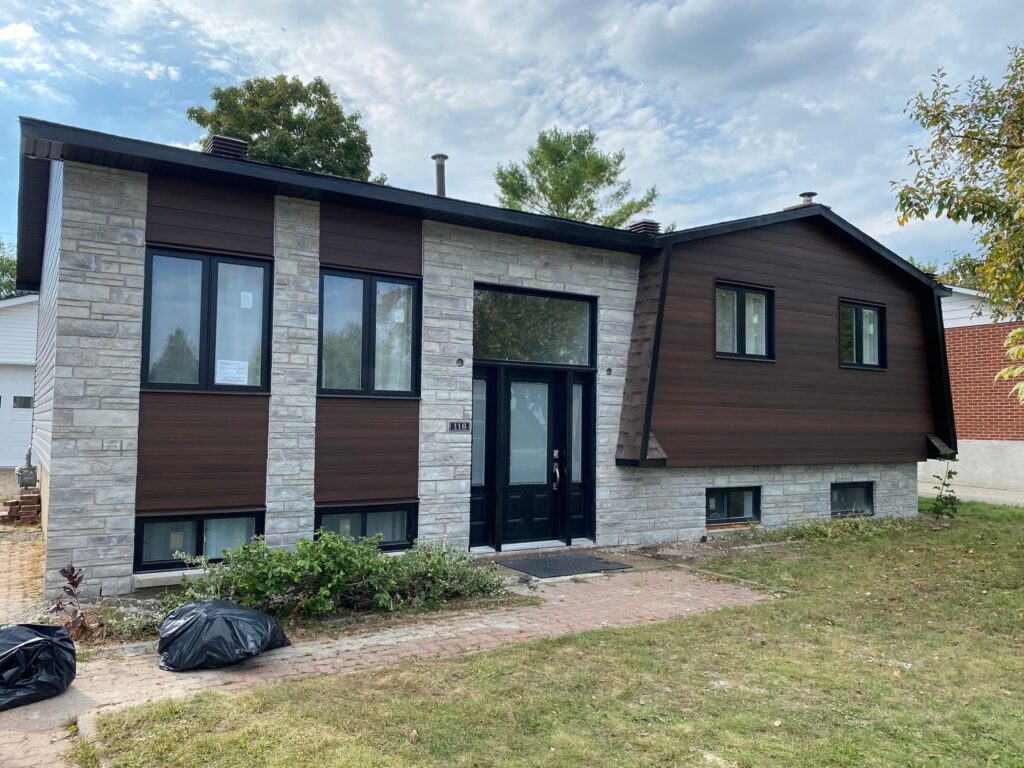
In Terrebonne, water that falls on a roof does not simply disappear: it runs down the walls, collects at the foundation, and looks for the shortest route to the basement. The area is bordered by the Rivière des Mille Îles, and the City takes this into account in its emergency measures: the Organisation municipale de la sécurité civile (OMSC) goes into monitoring mode during heavy rainfall or ice melt that could cause the river to overflow. The City also maintains a page on sewer backups, where it explains a simple mechanism: “A backup occurs because wastewater can no longer pass through because the pipe is blocked or clogged.” A gutter does not protect a city; it protects a building, provided it sends water to the right place.
Bylaw 225, Article 4.12: Where Your Downspout Water Must Go
This is what varies from one municipality to another, and what guides the work here. Municipal Bylaw 225, Article 4.12, governs roof-water drainage in Terrebonne. In practical terms, the stated requirement comes down to four points.
- Water collected by gutters and downspouts must be discharged at the surface.
- The discharge point must be at least 150 centimeters (1.5 m) from the building.
- You must prevent infiltration toward the building’s underground drain.
- Discharge into the municipal storm sewer or combined sewer system is permitted only when exceptional circumstances make surface discharge impossible.
In practical terms, outside of these exceptional circumstances: a downspout that goes into the ground to connect to the sewer does not belong there, nor does a downspout that empties against the wall. Water must be directed beyond the backfill area and allowed to flow above ground. This must be planned before drilling: outlet locations, the direction of the yard slope, and discharge points that do not direct water toward a driveway or a neighbour’s property.
The official text is published by the City of Terrebonne. A bylaw may be amended: confirm the requirement that applies to your address with the City before work begins.
Terrebonne’s Housing Stock and Sizing Choices
Terrebonne’s housing stock is documented by the City itself in the Portrait sociodémographique des villes de Terrebonne et de Mascouche, Recensement 2021 (Bureau de la planification stratégique et de la performance, October 2023), and corroborated by Statistics Canada’s 2021 Census Profile. These profiles describe the overall housing stock, not your roof. We therefore do not sell a “standard Terrebonne size”: sizing is measured on site, façade by façade.
Four factors determine the system, and Article 4.12 comes into play in each one.
- The roof area served by each gutter section, in sq. ft., and the roof slope. The larger the area and the steeper the slope, the faster water reaches the bottom of the roof: this is what can move a home to 6-inch gutters, with larger-diameter outlets.
- The number and location of downspouts. A long gutter run served by a single outlet will overflow at the corners. In Terrebonne, there is also a site constraint: every downspout must be able to discharge at the surface at least 1.5 m from the building. An outlet planned for a narrow passageway or against a fence must be moved during design, not after installation.
- Height and access. A two-storey home, cathedral roof, or backyard without clear access changes the fastening method and the length of linear feet installed in one continuous piece, without seams.
- The condition of the support. A gutter is only as secure as the fascia it is screwed into, and water-damaged fascia will not hold a full gutter channel.
Our Services in Terrebonne
Installation
Seamless aluminum gutters, cut on site to the length of the façade.
Downspouts and Compliance
Outlet locations, elbows, and extensions for surface discharge at least 1.5 m from the building, as required by Article 4.12.
Leaves and Ice
A gutter channel that holds water in winter puts strain on its hangers.
Fascia and Soffits
Gutter support and attic ventilation are addressed before installation.
Exterior Siding
Siding, caulking, and exterior insulation when the lower wall has been damaged by splashback.
What We Check On Site
| Point Checked | What We Look At |
|---|---|
| Fascia | The strength of the wood behind the aluminum, screw holding power, and warped or blackened boards beneath old hangers. |
| Slope | The direction and consistency of drainage toward each outlet, standing water, and sagging between two fasteners. |
| Outlets | The number of downspouts in relation to the roof areas they serve, as well as valleys and inside corners that concentrate water. |
| Ground clearance | The actual distance from the discharge point to the wall, the ground slope at that location, and the presence of an underground connection that needs to be disconnected. |
We show you what we see, including issues that are not related to the gutter: a yard that slopes toward the house cannot be corrected with an extension. The assessment also places your installation in relation to Article 4.12: if a downspout connects to an underground pipe, we identify it before proposing anything.
Contact Us
Gouttières et Revêtements Synergy is based at 580 Chem. de Lavaltrie, local 103, Lavaltrie QC J5T 0H1. We hold RBQ licence 5723-4940-01, are Alu-Rex ÉLITE Installer, CAA-Québec Recommended and APCHQ Certified.