
Gutters in Charlemagne | Bylaw 10-420-22 Compliant
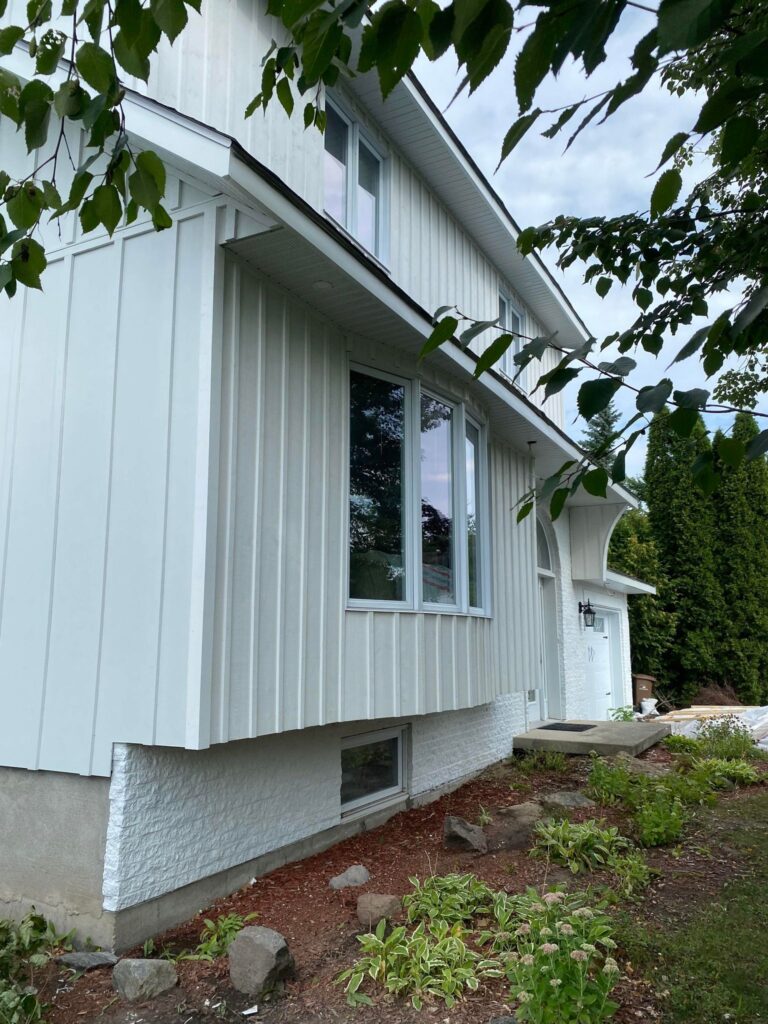
In Charlemagne, water from a roof always ends up somewhere. A poorly positioned downspout concentrates all the water from one roof slope in the same spot: against the foundation or toward the neighbouring property line. And if it goes into the ground at the base of the wall, it will almost always lead to the house drain. That is exactly what municipal regulations are intended to prevent.
Bylaw 10-420-22: Where Your Downspout Must Discharge
Charlemagne enforces Bylaw 10-420-22 regarding service connections. The requirement that directly affects gutters is as follows: rainwater from a sloped roof collected by gutters and downspouts must be discharged at the surface, at least 1.50 meters from the building, while preventing infiltration toward the building’s underground drain.
In practical terms, this means three requirements:
- At the surface. Water must discharge into the open, onto the property. It must not go back into a buried pipe connected to the drain.
- At least 1.50 meters from the building. The measurement is taken at the discharge point, not where the downspout runs along the wall: use an extension, offset elbow, or pipe that emerges at the surface beyond that distance.
- Without infiltration toward the drain. Discharging water at the required distance into a low spot that carries it back toward the house solves nothing: it will reach the drain from below. The ground grading matters as much as the length of the extension.
If your downspout enters the ground at the base of the wall, that is the typical situation that needs to be corrected. Regulations can change, and every property has its own conditions: confirm your situation with the City of Charlemagne before starting work. We carry out what is required; we do not interpret the bylaw for you.
Where Water Can Discharge on Your Property
The bylaw sets a distance. Your property determines whether that distance can be achieved and how the water can get there. That is what must be assessed on site before any solution is proposed.
Three questions are addressed during the site assessment:
- The side where water drains is not a minor detail. Each downspout needs a discharge point at the required distance that does not direct water toward the property line, driveway, stairs, or parking area. When space is limited, the decision comes down to tape-measure measurements.
- The number of outlets should be determined before the gutter size. Adding a downspout distributes the flow and shortens the distance water travels through the channel—often more useful than installing a larger gutter.
- The gutter size follows the roof area it collects. When one channel receives runoff from a large roof slope, a 6-inch gutter and larger downspouts can drain more water per outlet than a standard profile.
It is important to be clear about what a gutter can and cannot do. It cannot control flooding, a rising water table, or the capacity of the municipal system. But the water your own roof deposits against your foundation depends entirely on your downspouts and where they discharge it.
Our Services in Charlemagne
Installation
Seamless gutters formed on site, aligned with the fascia and sloped toward the selected outlets.
Downspouts and Compliance
Relocating outlets, elbows and extensions, and disconnecting downspouts connected to the drain.
Protection and Maintenance
Leaf guards, gutter maintenance, and ice buildup along roof edges.
Repair and Inspection
Leaking seams, detached sections, lost slope: we repair what can be repaired, and we say so when it cannot.
Fascia, Soffits and Capping
The gutter is attached to the fascia. If the board is damaged, we address it before fastening new material to it.
Building Envelope
Exterior cladding, caulking, and insulation when the work extends beyond the roofline.
What We Check On Site
| Point Checked | What We Look At | Why It Matters |
|---|---|---|
| Fascia | Condition of the board behind the gutter, water marks, and the security of the fasteners. | A new gutter fastened to softened fascia will sag again. The supporting surface must be addressed first. |
| Channel slope | Alignment toward each outlet, low points, buildup, and sediment. | A lost slope leaves water in the channel: standing water, added weight, and ice along the roof edge. |
| Outlets | Number, location, and size of downspouts in relation to the roof slope they serve. | Too few outlets and the gutter will overflow at the corner, even when it has been properly installed. |
| Ground clearance | Distance from the discharge point to the wall, ground grading, and the presence of a buried pipe. | This is where the requirements of Bylaw 10-420-22 come into play. |
| Access | Roof height, available setback, and obstacles at the base of the walls. | When setback space is limited, access determines the work method. |
Contact Us
Gouttières et Revêtements Synergy is based at 580 Chem. de Lavaltrie, local 103, Lavaltrie QC J5T 0H1. We hold RBQ licence 5723-4940-01, are Alu-Rex ÉLITE Installer, CAA-Québec Recommended and APCHQ Certified.